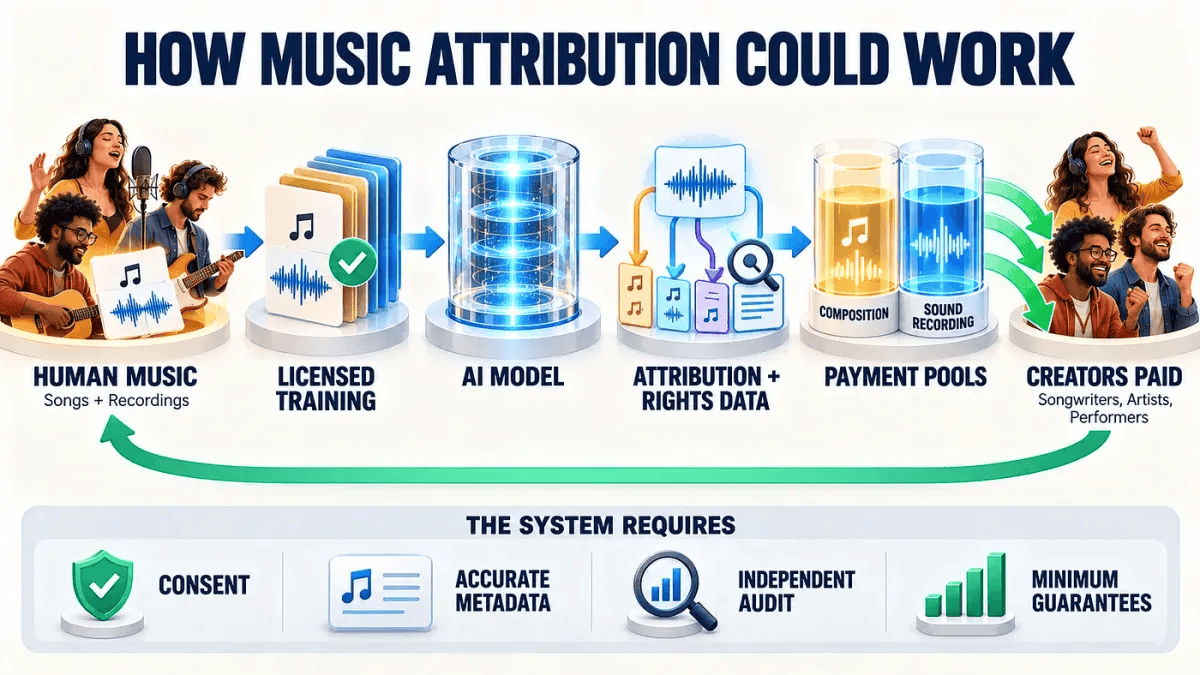
Attribution is crucial and very complicated. Photo Credit by Michael Whalen
AI may become very good at identifying influence without becoming any better at paying creators.
Attribution has become one of the music industry’s favorite answers to the AI problem. The promise sounds reasonable: identify the recordings and compositions that helped shape an AI-generated song, then credit and pay the people behind them.
As a composer, I want that system to work. I am not convinced that anyone has shown how it will produce meaningful income for most creators.
My skepticism is not only about the technology or the math. It is also about who is shaping the conversation. Too few of the people developing, negotiating and promoting AI attribution appear to have the interests of artists and rights owners at the center of their work.
I am not suggesting that no one cares. I am saying that incentives matter.
Watch this episode of the Artist Expansion Podcast for a “super friendly” introduction to attribution.
AI companies need access to music. Labels and publishers want new licensing revenue. Attribution companies want their technology adopted. Lawyers, consultants and administrators benefit when agreements are negotiated and new systems are built. Most of these participants are rewarded when a deal closes.
Artists and rights owners benefit only if they retain meaningful consent and control, the rates are adequate, the accounting is honest and the money actually reaches them.
That is a very different standard.
The attribution conversation is also difficult because several separate questions are constantly being collapsed into one:
-
- Was a work included in the training data?
-
- Did the AI company have permission to use it?
-
- Did the work influence a particular output?
-
- How much money should that influence generate?
-
- Who is legally entitled to receive the money?
-
- What remains after every split, deduction and administrative fee?
Attribution may help answer some of these questions. It does not answer all of them.
1. Attribution can identify influence but it cannot create permission
The word “attribution” is being used so broadly that it can mean almost anything.
Audio fingerprinting looks for an exact or recognizable match. Detection attempts to determine whether a piece of music was generated by AI. Provenance records where a file came from and how it was created or changed. Dataset disclosure identifies the material used to train a model.
Attribution attempts something more difficult: estimating which training examples influenced an output and how much each one contributed.
There are also two different moments when attribution can occur. Training-time attribution tries to determine how the original dataset shaped the model. Generation-time attribution examines material intentionally supplied when a particular output was created, such as a reference recording, uploaded track or licensed artist model.
Generation-time attribution may be easier to document because the system knows what the user supplied. Training-time attribution is much more difficult. A model may have learned patterns from hundreds of thousands or millions of examples, and different attribution methods may produce different answers.
Researchers including Choi and colleagues and Morreale and colleagues have proposed ways to trace training influence. The research is important, but there is still no universally accepted industry method that produces consistent results across different models.
Warner Music Group’s 2026 agreement to acquire Sureel AI shows where the major companies believe this is going. Warner said the Sureel registry contains millions of music assets and can track the use of components of a work in AI systems.
That may become valuable infrastructure. It still does not answer the economic question.
A report might show that a recording influenced an AI-generated song. It cannot prove that the AI company had permission to use the recording. It cannot establish a royalty rate. It cannot decide how the money should be divided between the composition and recording. It cannot force anyone to pay.
Attribution is evidence. Permission comes from a license. Payment comes from a contract or law.
Those distinctions matter.
2. Scale is the number that changes everything
The technology is complicated, but my central concern is basic math.
Meta disclosed that its MusicGen research model was trained on roughly 400,000 recordings representing about 20,000 hours of music owned by Meta or licensed for the project. That is one useful disclosure. Many commercial AI services still do not publish a complete training manifest, the number of model versions they have created or the number of generations their users produce.
The output side is expanding even faster.
In April 2026, Deezer reported receiving almost 75,000 fully AI-generated tracks every day. That amounted to more than two million tracks a month and approximately 44 percent of its daily uploads.
Deezer also said fully AI-generated music represented only 1 to 3 percent of streams and that as much as 85 percent of those streams were fraudulent.
Those figures cover one streaming service. They do not include the much larger number of generations that remain inside AI platforms, are discarded, are revised repeatedly or are used in private projects.
The scale creates two different denominators.
The first is the number of works used to train a model. The second is the number of outputs generated from that model. Both numbers may be enormous.
A creator cannot evaluate an attribution proposal without knowing:
-
- The total amount of money entering the system.
-
- The number of recordings and compositions sharing that money.
-
- The number of outputs being counted.
-
- Which outputs generate revenue.
-
- What level of influence triggers payment.
-
- Which deductions are taken before creators are paid.
A percentage can sound generous while representing almost nothing. Without the underlying numbers, the percentage is marketing.
3. One track can produce a crowd of claimants
A recorded song normally contains at least two separate copyrighted works.
The musical composition covers the music and lyrics. The sound recording covers the recorded performance and production. The U.S. Copyright Office treats them as separate works. Permission to use one does not automatically include permission to use the other.
That distinction is easy to state and difficult to administer.
A sound recording may be owned by an artist, a record company or several parties. A composition may have multiple writers, publishers and administrators. Their ownership percentages may vary by territory. Some shares may be disputed or missing.
The model may learn from melody, harmony, rhythm and lyrics. It may also learn from a singer’s phrasing, the sound of an instrument, a producer’s decisions, an engineer’s work or the timbre of a particular recording.
Voice, name and likeness create another set of rights that may not be covered by either the composition or sound-recording license.
The existing royalty system already shows how fragmented payment can become. The Mechanical Licensing Collective administers one category of U.S. digital mechanical royalties. Performance rights organizations, SoundExchange, labels, publishers and other administrators handle different rights and uses.
Attribution might identify a source recording. Before that information can produce a payment, the system still has to determine:
-
- Which right was used.
-
- Who currently owns that right.
-
- Which territories are covered.
-
- Whether the use was licensed.
-
- How co-owners divide the payment.
-
- What happens when ownership is disputed.
-
- What happens to unmatched money.
An attribution score is not a royalty statement.
4. Accurate fractions can still add up to almost nothing
The hardest question is not whether a system can calculate influence. It is whether enough money will enter the system to make that calculation economically meaningful.
The U.S. Copyright Office addressed this disagreement in its 2025 report on generative AI training. Some commenters argued that payments to individual creators would be negligible because of the number of works involved. Others argued that small payments can accumulate over time.
Both statements may be true. Neither tells an individual creator what to expect.
Consider a hypothetical $100 million annual pool:
-
- Divided among 100 million outputs, the average is $1.00 per output.
-
- Divided among 10 billion outputs, the average is $0.01, or one cent, per output.
-
- Divided among 100 billion outputs, the average is $0.001, or one-tenth of a cent, per output.
This is a stress test, not a forecast.
At 10 billion outputs, the pool provides an average of one cent per output. If an attribution system connects that output to 1,000 source works, the average becomes $0.00001 per work.
That amount must then be divided between the composition and sound recording. Each side may have several owners. Performers, administrators and collecting organizations may also have claims or deductions.
Influence weighting would not divide the cent equally. It would probably direct more money toward a small number of works. That may benefit the highest-scoring material while leaving most of the training catalogue with even less.
A pure pro rata system also transfers the risk of scale to creators. An AI company can generate more outputs without increasing the total amount of money in the pool. Every new output then reduces the average value of the existing claims.
The company’s product becomes more productive. The creator’s attributable share becomes less valuable.
More accurate accounting cannot repair an inadequate rate. It can only divide the inadequate rate more precisely.
5. The payment system will be built in contracts rather than code
The first licensing experiments are beginning to show what an AI payment system might look like.
STIM, the Swedish collecting society, says its AI license compensates rightsholders separately for training and generated output. Training revenue is divided equally among the musical works included in the license. Output revenue is distributed through attribution or, when attribution is unreliable, through a proxy based on how works were used in the training data.
This is a serious attempt to solve the problem. It also demonstrates the difficulty.
Equal division is simple to administer, but the math becomes familiar if millions of works share a modest pool. Proxy distribution may be necessary when attribution fails, but the choice of proxy can determine who receives the money.
STIM also says there is no established market standard and that it cannot yet say how much an individual creator will receive.
The National Music Publishers’ Association said its 2026 agreements with Udio and KLAY provide publishers with compensation equal to record labels on the training side. Equal treatment for the song and recording would be an important improvement over the economics of streaming.
It still does not tell us whether the total payment is adequate, how artists and songwriters participate, or what happens to settlements, advances and equity received by the companies negotiating the agreements.
A possible system within 36 months
By October 2029, I can imagine a licensed AI music market built around several payment pools rather than one universal fund.
Labels, publishers, collecting societies and distributors will negotiate separate agreements. The details will differ, but the basic structure may include three payment layers.
Payment for training
An AI company pays for the right to include music in a model. The payment is the greater of an annual minimum guarantee or an agreed percentage of subscription, advertising, API and enterprise revenue.
A new model or substantial retraining requires a new license and another payment.
Training compensation is owed because the catalogue helped build a commercial product. It should not depend entirely on whether anyone can trace a particular output back to one recording.
The training payment is divided between a musical works pool and a sound-recording pool. Publishers and collecting societies administer the composition side. Labels, distributors and master rights organizations administer the recording side.
Performers and session musicians will need a protected share or many of them may receive nothing. Independent artists and writers will probably participate through distributors and collective licenses rather than negotiating with every AI company individually.
Payment for outputs
A separate pool covers generated music that is released, monetized or used commercially.
Outputs with a strong and independently verified connection to specific works receive a larger share. When attribution confidence is low, the system uses a broader distribution method rather than dividing a microscopic payment among thousands of supposed sources.
Artist-specific voice models, name and likeness uses, remixes, continuations and deliberate imitations require separate consent and higher rates.
A shared rights system
The industry will need a clearinghouse connecting recording identifiers, composition identifiers, ownership shares, territories, consent and model permissions.
DDEX already provides standards for exchanging recording and musical works data and is examining metadata for AI-generated music. That offers a starting point, but it is not a complete global rights database.
Under a credible system, AI companies would report their datasets, model versions and commercial outputs. Labels and publishers would aggregate small amounts and issue quarterly payments. Conflicting ownership claims and unmatched royalties would be held in escrow.
Creators would receive statements showing which service used their work, which license applied, how their payment was calculated and which deductions were taken.
That is the possible future.
It is not the same as the probable outcome.
The people at the table will determine the outcome
This is where my deepest skepticism begins.
The people negotiating these agreements often control the information used to evaluate them. A creator may never see the complete training dataset, the total license fee, the attribution formula, the size of an advance, the value of an equity position or the way money is allocated between recordings and compositions.
AI companies benefit from legal certainty. Labels and publishers gain new licensing income. Attribution providers benefit when their technology becomes part of the system. Lawyers, consultants and administrators are paid to create and manage the agreements.
The artist or songwriter may be the last person to learn what was negotiated in their name.
This does not mean every participant is acting in bad faith. It means their interests are not automatically the same.
Too few people in the attribution conversation appear to begin with the question that matters most to creators:
Does this system leave the artist or rights owner materially better off?
A company may describe a deal as “fair” because the music was identified and a payment was calculated. That does not mean the artist consented to the use, understood the formula or received an economically meaningful amount.
The Council of Music Makers addressed this risk in its September 2026 guidance. It urged creators to ask whether labels and publishers receive lump sums, advances, settlements, revenue shares or equity; how those forms of value are allocated; and whether creator payments are applied against old unrecouped balances.
Those are not secondary details. They determine where the money goes.
Before supporting an AI licensing system, I would want clear answers to the following questions:
-
- Was each work licensed for a named service and model?
-
- Can an artist or songwriter decline participation or withdraw after the license expires?
-
- Are the composition, sound recording and performer interests all covered?
-
- What is paid for training and what is paid for output?
-
- Is the payment the greater of a minimum guarantee or a defined share of revenue?
-
- How are settlements, advances, equity, administrative fees and recoupment treated?
-
- Do creators participate in every form of value received by their representatives?
-
- Can an independent party audit the dataset, attribution method, revenue base and royalty statements?
-
- Can creators correct ownership data, challenge a result and recover disputed or unmatched money?
If the answers are confidential, incomplete or controlled entirely by the parties receiving the money, the system is not transparent enough.
The real test
I expect licensed AI companies to pay into training and output funds. I do not expect one universal fund, and I do not assume that the first agreements will be fair.
The likely result will be a patchwork of direct licenses, collective agreements and regional rules. Some will be responsible experiments. Others may use the language of attribution to make an inadequate deal sound equitable.
I am not skeptical because I believe attribution technology is useless. Attribution could become an essential layer of evidence and accounting.
I am skeptical because a technically accurate system can still legitimize an economic arrangement designed without meaningful creator participation.
Too few people in the current conversation are rewarded for saying that the fund is too small, the terms are unfair or the creator’s share is meaningless. Most of the commercial participants are rewarded for getting the system licensed and operating.
A database can tell us who may be owed. It cannot decide what their work is worth. It cannot guarantee that artists and songwriters participated in the negotiation. It cannot prevent confidential advances, equity, administrative fees and recoupment from absorbing much of the value before creators are paid.
If the fund is inadequate, attribution will divide an inadequate payment with greater precision. A company may then point to the precision of the calculation as evidence that the system is fair.
Before anyone declares the problem solved, artists and rights owners should have a seat at the table, meaningful consent, access to the financial terms, independent audit rights and a guaranteed share of every form of value generated by the agreement.
The final question is not simply whether AI music can be attributed. It is determining who the attribution system was designed to serve…
Sources and data:
Warner Music Group. Warner Music Group Acquires Sureel AI, June 10, 2026.
Meta AI. Open Sourcing AudioCraft, August 2, 2023.
Deezer. AI Generated Tracks Now Represent 44 Percent of All New Uploaded Music, April 20, 2026.
U.S. Copyright Office. Copyright and Artificial Intelligence Part 3 Generative AI Training, May 2025.
U.S. Copyright Office. Copyright Registration for Sound Recordings Circular 56.
The Mechanical Licensing Collective. How It Works.
STIM. AI License Information and Creator FAQs, 2025 and 2026.
National Music Publishers’ Association. NMPA Inks Deals With Udio and KLAY, June 10, 2026.
Council of Music Makers. Guidance for When Considering AI Proposals From Labels and Publishers, September 23, 2026.
DDEX. Recording and Musical Works Data Standards and AI Working Group Information.
Choi and colleagues. Large Scale Training Data Attribution for Music Generative Models via Unlearning, 2025.
Morreale and colleagues. Attribution by Design, 2025.