
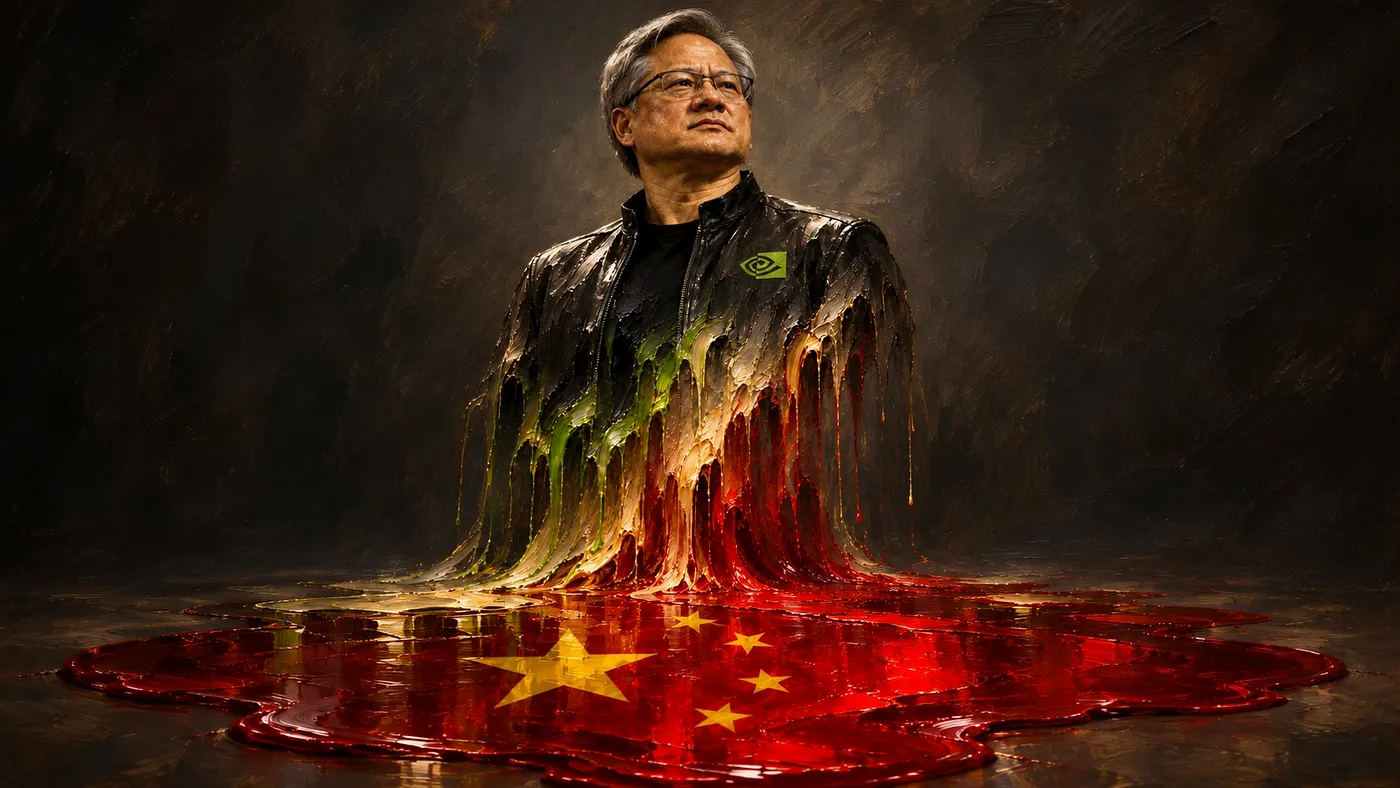
Jensen Huang, Arthur Schopenhauer, and all the things we risk losing.
On November 12, 2026, Jensen Huang resigned as president and CEO of Nvidia, the company he co-founded in 1993 and spent thirty-three years transforming into one of the most valuable enterprises in the world. Nvidia’s board accepted his resignation on November 11 and announced that longtime chief financial officer Colette Kress would serve as interim CEO while the company searches for a permanent replacement. Harvey C. Jones, a director since the company’s earliest days, was appointed Nvidia’s first chairman of the board.
It is a remarkable turn of events for a man whose name had become almost synonymous with the artificial intelligence revolution. Huang was more than a successful corporate executive. He was the architect, principal strategist, and public face of a company that helped reshape the direction of global technology. His professional accomplishments required extraordinary intelligence, discipline, perseverance, and the willingness to make decisions that other people considered impossible.
And yet, in the space of roughly a week, his public life unraveled. On November 8, Huang apologized to his wife, family, and employees for his infidelity. Four days later, the company he had devoted most of his adult life to building announced his departure. The contrast is almost incomprehensible: thirty-three years of achievement, followed by a few extraordinary days in which his reputation and professional future were fundamentally altered.
I have been following this story with a mixture of disbelief, fascination, and empathy. I am not particularly interested in joining the public condemnation of Huang. There will be plenty of that, and some of the criticism will undoubtedly be justified. What interests me is understanding how someone capable of such extraordinary judgment in one area of his life could apparently exercise so little of it in another.
Part of my interest comes from personal experience. I have imploded my own romantic life several times over the decades. I have never cheated on a wife or partner, but I have made decisions that changed the course of my life, sometimes in ways I couldn’t fully appreciate until much later. I know how easy it is to become absorbed in the immediate circumstances of a relationship while failing to recognize the larger consequences of my choices. I also know the uncomfortable experience of looking back and wondering how something that now seems obvious could have been so difficult to see at the time. Divorce and hindsight suck.
But there is something about the Huang situation that I find particularly difficult to understand. Does there come a point in someone’s success when the ordinary things most of us have at stake somehow lose their importance? Does enormous wealth, power, and influence create an illusion that the consequences governing everyone else’s lives simply no longer apply?
Perhaps success creates a strange kind of blindness?
If you spend decades taking extraordinary risks and succeeding, it must become increasingly difficult to distinguish confidence from certainty. You have challenged conventional wisdom, ignored the advice of people who doubted you, and repeatedly demonstrated that your instincts were correct. At some point, perhaps you begin to believe that your judgment is exceptional in every circumstance, including those where your professional accomplishments provide no particular insight or advantage.
This may be one of the more dangerous consequences of extraordinary success. The qualities that make someone brilliant in business can become liabilities when carried into personal relationships. Boldness becomes recklessness, confidence becomes entitlement, and the ability to manage enormous professional risks creates the illusion that personal risks can be managed just as effectively. There is a quiet arrogance in believing that because you have mastered one part of life, you have somehow mastered all of it.
What makes Huang’s situation particularly troubling is that the consequences now extend far beyond his private relationships. Nvidia faces the abrupt departure of the only CEO it has ever known, at a moment when its technology, financial commitments, and strategic decisions affect enormous portions of the global economy. The board must establish new leadership, restore confidence, address questions about its own oversight, and convince customers and partners that the company’s direction remains secure.
The financial repercussions have been immediate. Nvidia shares fell as much as 14 percent during trading on November 12 before recovering to close 4.3 percent lower. Its recent market decline has erased hundreds of billions of dollars in shareholder value, although broader concerns about AI valuations and investment spending have contributed to those losses. The turmoil has also affected companies throughout the AI ecosystem, including data-center operators and businesses that depend on Nvidia’s technology and financing.
That is a responsibility of an entirely different magnitude. Investors have entrusted their savings and retirement funds to Nvidia’s future. Employees have built careers around the company’s mission. Customers have committed billions of dollars to infrastructure projects that depend on its ability to deliver. Huang’s decisions have introduced uncertainty into an organization whose success depends, in considerable part, on the confidence others place in its leadership.
The wider implications are equally significant. Nvidia is not simply a semiconductor manufacturer. Through its chips, software, partnerships, and investments, it occupies a central position in the development of artificial intelligence. Questions about its leadership can influence investment decisions throughout an industry that is already struggling with concerns about financing, regulation, and whether the enormous sums being spent on AI will produce adequate returns.
None of this means Nvidia’s technological achievements have disappeared or that its future is necessarily compromised. The company has tens of thousands of talented employees, formidable intellectual property, and an established position in an industry whose importance continues to grow. But it does mean that Huang’s personal conduct has created problems that other people must now solve, and risks that many of those people never agreed to assume.
There is also the extraordinary question of what people inside Nvidia knew. According to reporting by The Information, Huang’s alleged relationship with a company executive had been discussed among employees for years. If those accounts are accurate, they raise uncomfortable questions about the environment surrounding a powerful founder. Were people reluctant to challenge him? Did his importance to the company make ordinary standards of accountability difficult to enforce? And were the people responsible for protecting the organization sufficiently independent of the person who had built it?
Then there is the national-security dimension, which takes the situation into even more disturbing territory. American intelligence officials reportedly suspected that Alice Huang, a businesswoman associated with Nvidia customer Megaspeed International, was connected to Chinese intelligence. The extent of any intelligence operation, what information may have been sought or obtained, and what Jensen Huang understood remain uncertain. Nvidia’s board has stated that it has no reason to believe company secrets or national security were compromised, and it initiated an independent investigation.
I find the broader vulnerability almost as astonishing as the allegations themselves. A person occupying Huang’s position would presumably have access to extraordinary legal, security, and intelligence expertise. Surely people at that level are advised about personal relationships, potential conflicts of interest, and the possibility that others might seek access or influence through them. Yet even the most sophisticated security apparatus cannot protect someone who disregards its advice or believes that a particular relationship is somehow exempt from ordinary scrutiny.
This is something I have become increasingly conscious of in my own life. My wife is the person with whom I feel completely secure, but outside my marriage I am careful about the intentions of people who approach me, particularly when professional opportunity or public recognition may be involved. I sometimes wonder whether someone is genuinely interested in knowing me or simply sees an opportunity, a sale, a useful connection, or some other advantage. I don’t believe that every relationship is transactional, and I have many meaningful friendships with women. But I have learned to be deliberate about boundaries and clear about what a relationship is and isn’t.
That awareness comes partly from experience and partly from understanding that ambiguity can create complications neither person originally intended. It isn’t about assuming the worst of people. It is about recognizing that attention, admiration, professional interest, and personal attraction can become entangled surprisingly easily. I find it remarkable that people with vastly more influence, exposure, and responsibility sometimes appear less cautious about those complications than the rest of us.
The German philosopher Arthur Schopenhauer offers an interesting framework for understanding this contradiction. Schopenhauer believed that beneath our rational thinking lies a fundamental force he called the Will, a relentless and largely irrational striving that drives human existence. We continually pursue satisfaction through achievement, possession, recognition, pleasure, and the fulfillment of our desires. But satisfaction is rarely permanent. Once one desire has been fulfilled, another emerges to take its place.
In Schopenhauer’s view, human intelligence does not necessarily free us from this restless pursuit. Often, our reasoning becomes a sophisticated instrument for satisfying what we already want. We convince ourselves that our desires are reasonable, our circumstances are exceptional, or our actions are somehow justified by considerations that might not withstand more objective scrutiny.
This presents a fascinating paradox for exceptionally successful people. The determination that allows someone to pursue a seemingly impossible professional objective may coexist with an inability to recognize when another pursuit is unwise. Success can expand our possibilities without necessarily improving our judgment about which possibilities deserve to be pursued. Having more opportunities is not the same as having greater freedom from desire.
Of course, I cannot know whether any of this explains Huang’s decisions. His motivations, his marriage, and his personal relationships are far more complicated than anything an outsider can understand through news reports. But Schopenhauer’s philosophy suggests that the problem may be less about a failure of intelligence than about the limitations of intelligence itself. We can be extraordinarily capable of understanding the world while remaining surprisingly confused about ourselves.
This is where the idea of discipline becomes especially interesting to me. We celebrate discipline as the foundation of greatness, and with good reason. Whether someone is composing music, building a company, writing a book, or pursuing a scientific discovery, meaningful accomplishment generally requires sustained attention, sacrifice, and the ability to postpone immediate gratification in service of something larger.
But there is another kind of discipline that receives considerably less attention. It is the ability to recognize when something we want may threaten something we already value. It requires us to acknowledge our vulnerabilities, question our rationalizations, and understand that restraint can sometimes be more important than ambition.
Schopenhauer also placed enormous importance on compassion. He believed that genuine ethical awareness begins when we recognize the reality of another person’s experience rather than viewing the world exclusively through our own desires. That seems especially relevant here, because the consequences of Huang’s decisions are not limited to the damage to his career. His wife, children, and family must contend with a deeply personal betrayal that has become an international public spectacle.
In his November 8 apology, Huang acknowledged that his actions had hurt his wife and children and damaged the life they had built together. I found that acknowledgment important, although an apology cannot determine what happens next. His family deserves privacy, compassion, and the freedom to work through the situation without the rest of the world treating their lives as entertainment.
I feel compassion for Huang as well. There must be something profoundly disorienting about watching a career and reputation built over three decades become the subject of such intense public scrutiny. Understanding that his choices brought about these consequences does not require us to take pleasure in his humiliation. Nor does empathy require us to ignore the responsibilities he had to the people who trusted him.
And that brings me to what may be the most significant loss of all: his reputation.
For decades, Huang represented an almost idealized version of the technology entrepreneur. He was disciplined, visionary, technically brilliant, and seemingly capable of anticipating the future before almost anyone else. His story was one of perseverance and long-term commitment, qualities that made him an admired figure well beyond Silicon Valley.
Today, that story is being reconsidered. His accomplishments remain extraordinary, but his public identity has changed in a matter of days. He is no longer being discussed exclusively as the man who helped build the modern AI industry. His name is now associated with infidelity, questions of corporate governance, and allegations involving foreign intelligence, even though the most serious national-security questions remain unresolved.
Reputation is a peculiar form of wealth. It takes years to establish and depends on an accumulation of small and large demonstrations of character, judgment, and reliability. Yet it can be profoundly damaged by a remarkably short sequence of events. Unlike financial wealth, it cannot simply be replenished through another successful quarter, another extraordinary product, or another brilliant business decision.
I don’t believe Huang’s professional accomplishments should be erased by his personal failures. History should be capable of recognizing both his remarkable contributions and the consequences of his conduct. But a reputation is more than a record of achievements. It is also the confidence people place in someone’s judgment, and once that confidence has been shaken, rebuilding it can be considerably more difficult than establishing it in the first place.
Perhaps that is what I find so unsettling about this entire episode. We spend enormous amounts of time learning how to succeed, but comparatively little time learning how to live with success. We develop the habits, skills, and determination required to accomplish extraordinary things without necessarily developing the wisdom to recognize when the pursuit of another experience or desire might jeopardize what we have already built.
I hope Huang and his family find a way through this that allows for understanding and healing. I hope Nvidia emerges from the crisis with the stability and leadership necessary to continue its important work. And I hope that, with time, the public discussion can move beyond scandal toward something more useful about ambition, judgment, and human vulnerability.
What I take from this story is not that successful people are uniquely flawed or that the pursuit of greatness inevitably leads to personal failure. It is that achievement does not exempt any of us from being human. Our accomplishments can be extraordinary while our judgment remains imperfect, and the experience of being right about so many things can make it harder to recognize when we are terribly wrong about something else.
Maybe the most important form of discipline isn’t always the determination to keep pursuing what we want. Perhaps it is the ability to recognize the value of what we already have, and the humility to understand how easily it can be lost.
There is something profoundly sad about spending thirty-three years building a remarkable legacy, only to see its meaning transformed in the space of a week. The company may recover, the industry will continue, and the passage of time may eventually restore some measure of Huang’s public standing. But the events of these past several days demonstrate that even the most accomplished among us remain vulnerable to a strange kind of blindness: the inability to recognize, in the moment of wanting something more, just how much we already stand to lose…


