
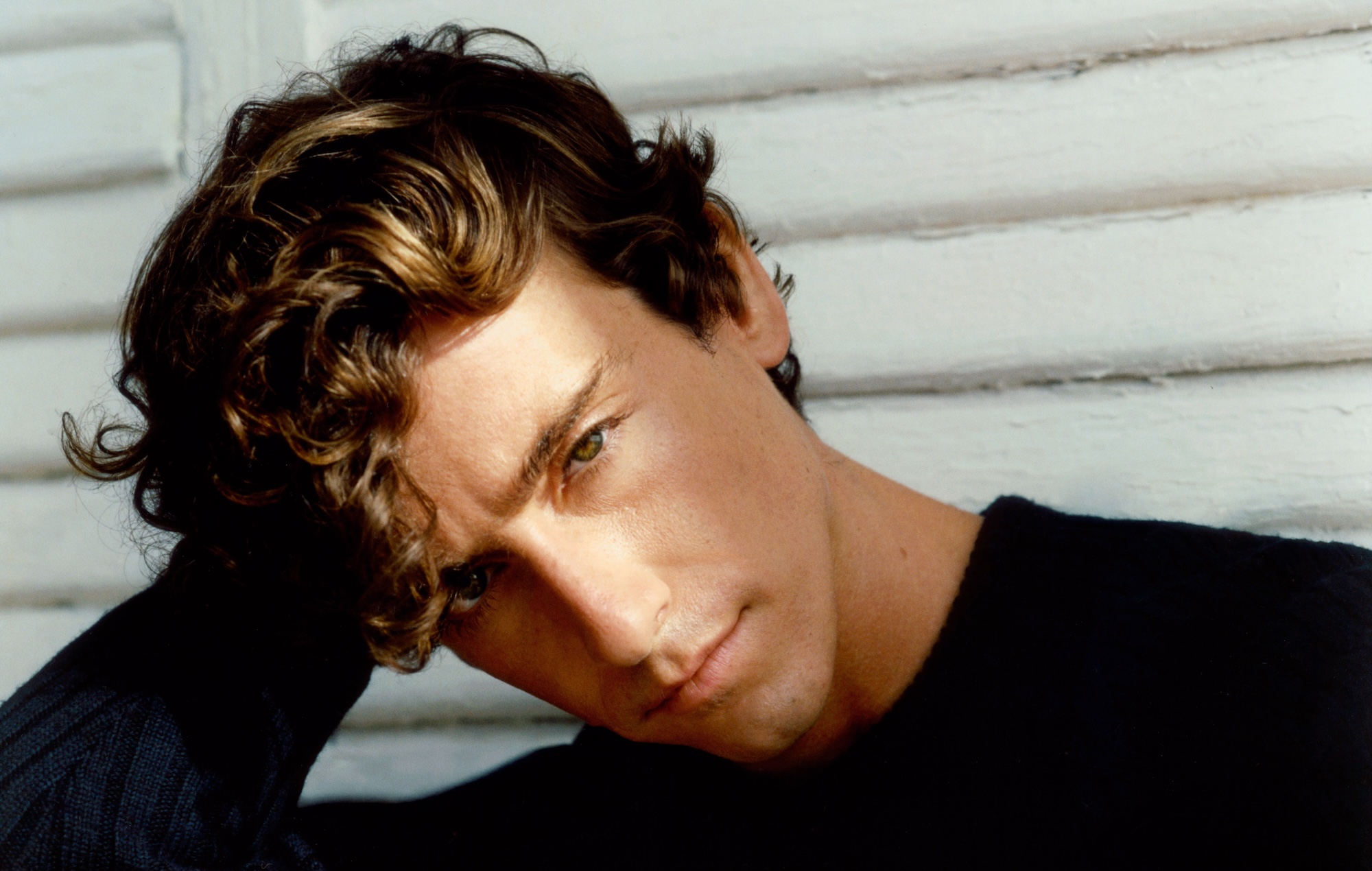
When Los Javis first approached Álvaro Lafuente Calvo – better known as the musician Guitarricadelafuente – about their new, queer Spanish Civil War epic La Bola Negra, he assumed they wanted him to contribute a song to the soundtrack. He was half right. The directors – Javier Calvo and Javier Ambrossi – also wanted the artist, who’d never acted before, for the leading role of Sebastian, a reluctant, wide-eyed fascist soldier who catches feelings for the wounded Republican lieutenant, Rafael (played by Miguel Bernadeau).
“When they asked me, I was so fucking terrified,” recalls Lafuente, who first met the Javis at Barcelona’s Primavera Sound in 2024, where he joined Troye Sivan on stage to perform their collaboration ‘In My Room’. “It was a frightening challenge, because it involved so many delicate topics: [the Spanish poet Federico Garcia] Lorca, the Spanish Civil War, queer stories. I felt a big sense of responsibility.”
The film features his song ‘La Nieve’, a sweeping, delicate and sob-inducing track on par with Sufjan Stevens’ Call Me By Your Name tearjerker ‘Mystery of Love’. Here, Lafuente achieves a rare feat in modern cinema: to write an original song that is just as emblematic of the film itself. He wrote it on “the most difficult day of [the] shoot, ever”, during which the 29-year-old musician-turned-actor wrapped his last scene in Cantabería after filming in the pouring rain for five hours. When he got home at 1am – “this sounds corny,” he notes – he began to write. “I had this upright piano and the melody… and the ‘mira, qué tontería’…” he smiles while singing one of its most recognisable lines.
Lyrically, the song takes cues from Federico García Lorca’s poem ‘El Amor Duerme en el Pecho de Poeta’ [‘The Beloved Sleeps In The Poet’s Breast’], from the collection Sonnets Of Dark Love, considered his most explicitly queer work. Featured in the film, the poem is thought to be written for his last great love, Rafael Rodríguez Rapún. Both Lorca and Rapún were killed during the Spanish Civil War.
Initially, Lafuente thought ‘La Nieve’ would soundtrack the film’s credits – but it actually appears at the narrative’s climax, where three separate storylines collide. “The nieve, the snow, represents the end of a journey. To see the three characters… realise what [they] need to do before it’s too late – that’s when they start to see the snow coming,” he says. “It was beautiful.”
‘La Nieve’ has been touted as a frontrunner for Best Original Song at the Oscars, while La Bola Negra is hotly tipped to beat Nolan’s The Odyssey for Best Picture. Calling from a break in the film’s packed US press tour, Lafuente exudes a humble giddiness. He replies to each question with detailed, lengthy answers, broken up by laughs that suggest disbelief at his current circumstances. “It’s just bonkers, everything is so overwhelming but at the same time so exciting – how people [have] embraced this story that at first seemed so local [and], in a way, very Spanish; how it’s being embraced so magically abroad.”
While Lafuente may still feel shocked that Los Javis enlisted him for the role, his interest in the Spanish Civil War was apparent far before his turn as Sebastian. His song ‘Antes De Que Quieras Olvidar’, from his 2022 folk-oriented debut album ‘La Cantera’, is a softly sung, acoustic meditation muddied with electronic textures that blends into a sample of Woody Guthrie’s 1937 Spanish Civil War commentary, ‘Jarama Valley’.
“I’ve always been so interested in that moment of time, and in the songs,” he explains. “The Spanish Civil War involved everybody – our families, grandparents. My grandfather had to live what Sebastian lives in the film. If your village belong[ed] to a certain side, you ha[d] to fight for them or face the consequences.”
“When Los Javis asked me to be in La Bola Negra, I was so fucking terrified”
He learnt to play guitar at his grandparents’ house in Aragon in northeast Spain, where he first heard the rhythms of the jota – a style most present on ‘La Cantera’’s anthemic and rousing ‘La Filipina’. “I learnt [the jota] in my grandparents’ village,” he says. “It was linked to my family.” That’s why his music is so intertwined with the guitar, the instrument that forms part of his stage name and which he refers to as “both my shield and my gun”.
His folk interest remained embedded in his second album, ‘Spanish Leather’, the title borrowing from Bob Dylan’s long-distance breakup ballad, ‘Boots of Spanish Leather’. “It speaks to this exotic idea of Spain from abroad – like Spanish leather is a mark of endurance, which is funny, as in Spain you don’t refer to cuero español,” he explains. “Spain is a difficult country. We cannot stand ourselves; culturally, we’ve always been ashamed of our traditions as they were linked to our past.”
He breaks down his point generationally. His grandparents took part in the 1950s rural exodus, which saw agricultural workers move from the countryside into Spain’s major cities and “wanted to forget those songs that they sang while labouring in the field, or going to Mass”. The next generation, his parents, were raised in the city, looking forward to the future rather than back to Spain’s past. Now, he feels that his contemporaries – from the flamenco palmas of Rosalía to the Galician tambourines of Tanxugueiras – are unafraid to embrace traditional music. “I feel our generation doesn’t feel that shame,” he says.
And while ‘Spanish Leather’ has its folk moments – the upbeat, self-love hit ‘Full Time Papi’ is led by the zanfona, a Galician hurdy-gurdy that dates to the medieval period – it’s very much cloaked in pop star sex appeal: from the music to its accompanying photography, which sees Lafuente, muscled and shirtless, shot by Wolfgang Tillmans. The music videos, too, feature the torsos of toned and unclothed men. This sensuality is part of the core exploration through which Lafuente has come to terms with his own sexiness as a gay man, which sees the album’s title take on a second meaning. “I’ve encountered the link between leather as a kink or something erotic and the image of the past, the endurance of tradition,” he says. “It’s a journey of self-discovery, how everyone finds their place on earth. I felt more comfortable in my own skin.”
Guitarricadelafuente. Credit: Jorge Perez OrtizFor this, there’s one peer he feels especially indebted to: Troye Sivan. The pair not only collaborated on ‘In My Room’, but also featured together on a remix of ‘Spanish Leather’s ‘Midsummer Pipe Dream’. Lafuente credits the seasoned Australian pop star with helping him find his confidence. “The relationship [Troye] has with his body really inspired me. Being empowered by your body while showing your vulnerability – I find that thin line so beautiful.”
Lafuente may have been apprehensive about his acting debut, but his on-screen performance has won widespread critical acclaim and touched the hearts of moviegoers worldwide. In October, midway through the film’s press campaign, he brought the ‘Spanish Leather’ tour to an end in Madrid’s Movistar Arena, where he performed ‘La Nieve’ live for the first time. As he softly sounded the trumpet he learnt to play for his role as Sebastian, the audience sang the song back to him word for word, while his La Bola Negra castmates blended into the sea of adoring Guitarrica fans.
“[Sebastian] was something that lived in me. I had to live the story fully to soak up [his] emotional baggage,” Lafuente reflects. He has announced he is already working on the follow-up to ‘Spanish Leather’, while continuing to promote La Bola Negra as the Oscar buzz grows louder. But beyond the awards, Lafuente maintains that the most important part of this journey was telling queer stories that had been silenced for far too long. “Obviously I’m biased as I took part in the story, but it can be so helpful. This is a film that doesn’t try to lecture, but tries to bring a spark of hope.”
La Bola Negra is in cinemas now. Its soundtrack is out now. The film streams on Netflix from December 2.
The post Guitarricadelafuente is proudly embracing Spain’s traditional sounds, and himself appeared first on NME.