Photo Credit: Techivation
When Hamburg musician André Grafet, who records as Colored Tears, released DECAY / TIME, a 23-song tribute to the 1980s Swedish post-punk band Twice a Man, he says every note was played, programmed, and sung by him using a combination of Cubase, Sequential synthesizers, and Native Instruments’ Kontakt—no generative AI involved.
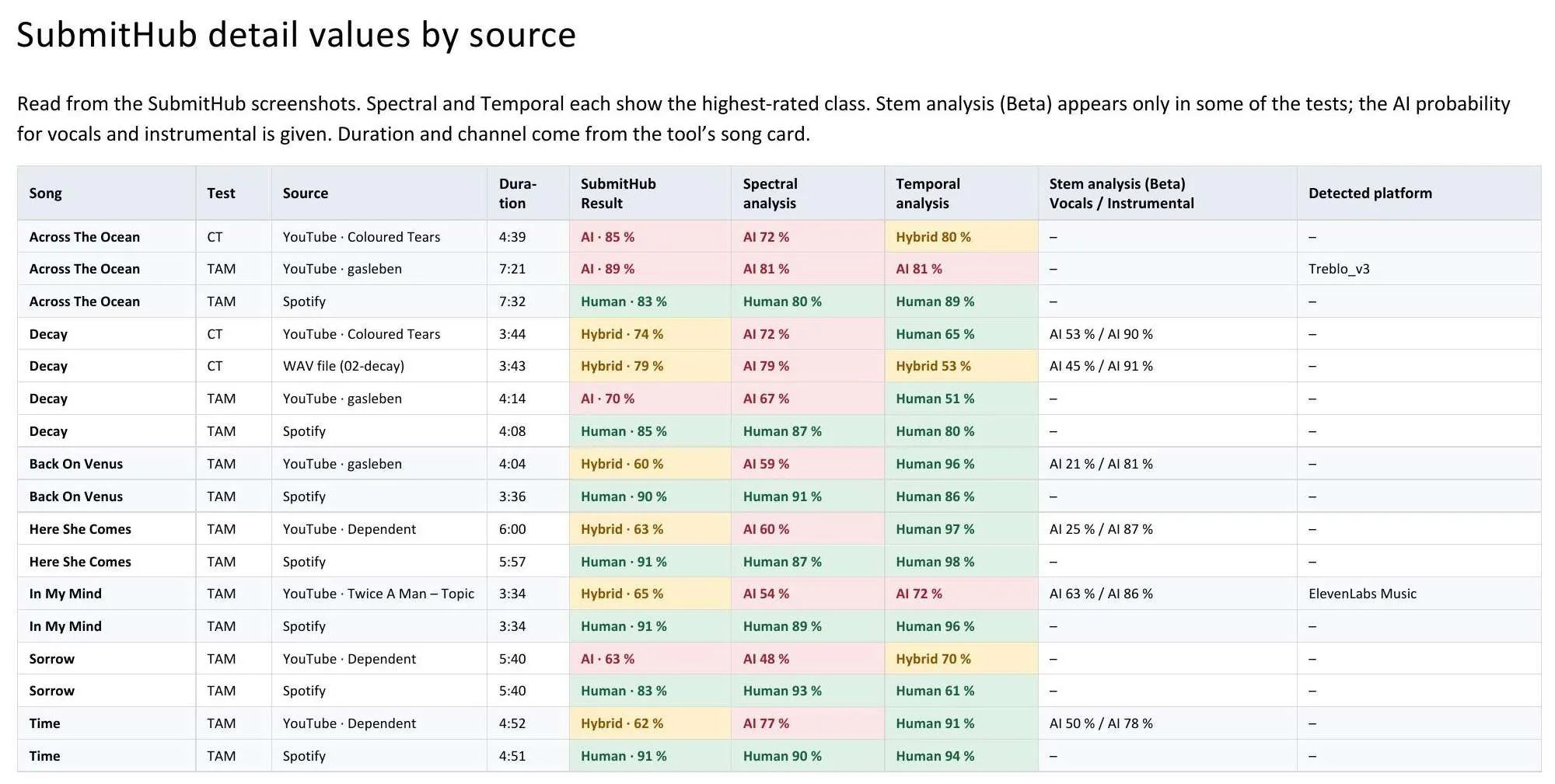
SubmitHub’s AI detector nonetheless rated all 23 tracks a mostly AI or hybrid work, while other detectors tested (ACRCloud, Let’sSubmit, Track Verifier) mostly agreed. Twice a Man’s own recordings from the 1980s didn’t fare much better, with seven of the originals form 1982 to 1986 coming back as AI or hybrid on SubmitHub when tested by YouTube link. Two even picked up a named platform, ‘Treblo_v3’ for 1984’s “Across the Ocean” and ‘ElevenLabs Music’ for 1982’s “In My Mind.”
SubmitHub reached out to Digital Music News after the original article to push back. A result like “93% human” doesn’t mean seven percent of a song was machine-made, only that the model is highly confident that the track is human, since classifiers almost never return 100% certainty even for recordings known to be human.
Photo Credit: Ines Weidemann of IAM
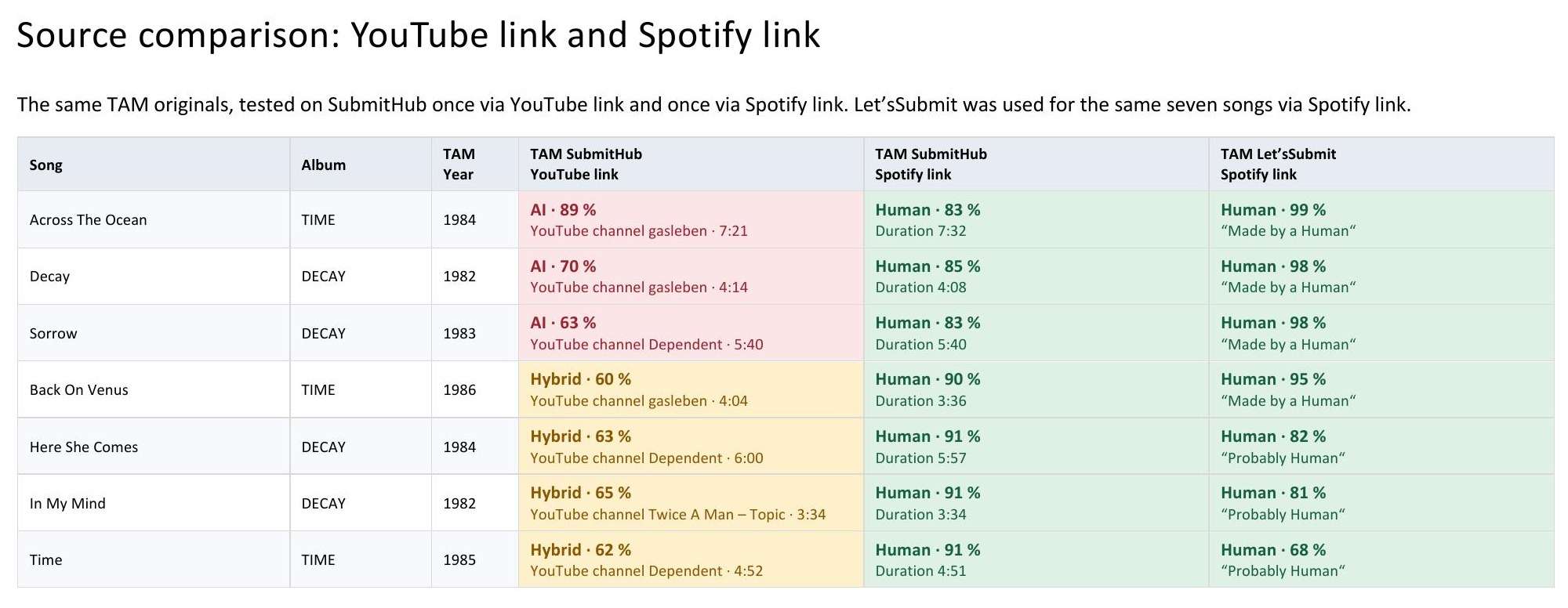
SubmitHub tested the 1982 Twice a Man album and said the reported scores were between 85% and 95% human on all ten tracks. Those results line up with what the comparison testing found when it ran the same originals through SubmitHub by Spotify link, where all seven came back as human with “Decay” at 85%, “Sorrow” at 83%, and “In My Mind” at 91%. The flagged results came from the YouTube links used to analyze these tracks.
Jason from SumbitHub notes that low-quality YouTube audio is discouraged and that the YouTube copy of “In My Mind” returns a potential false positive. But that’s precisely the problem, with a fan, blogger, or a playlist curator may paste a YouTube link into the AI detector.
Photo Credit: Ines Weidemann of IAM
That’s where a probablity percentage gets turned into a verdict. SubmitHub’s own results page tells users that anything at 85% or above is not accepted on the paltform, which makes a score the company describes as statistical confidence worth in practice, like a pass or fail line. Most people without a background in reading statistical probability seeing ‘82% Ai/Hybrid’ will take that to mean the song was most likely made with AI.
For artists who self-distribute through services like Bandcamp, that can put a whole catalog at risk. Deezer reports that AI tracks make up more than half of the new music delivered to its platform, so platforms have every incentive to act on automated flags.
How often such flags are wrong is the harder question to answer. SubmitHub’s Jason cited a UMG-commissioned test that put the SubmitHub detector at 99.3% accuracy and called DMN’s classification of ‘rampant’ unsupported.
Meanwhile, the Colored Tears campaign argues that the ‘over 99%’ figure rests on confidential industry benchmarks and that 31% of artists whose music SubmitHub has classified as AI said they had not used it. A peer-reviewed study published in the Transactions of the International Society for Music Information Retrieval (TISMIR) found 4.7% false alarms on human music detected by a commercial detector (not SubmitHub)—a rate that could add up to millions of errors at platform scale.
Photo Credit: Ines Weidemann of IAM
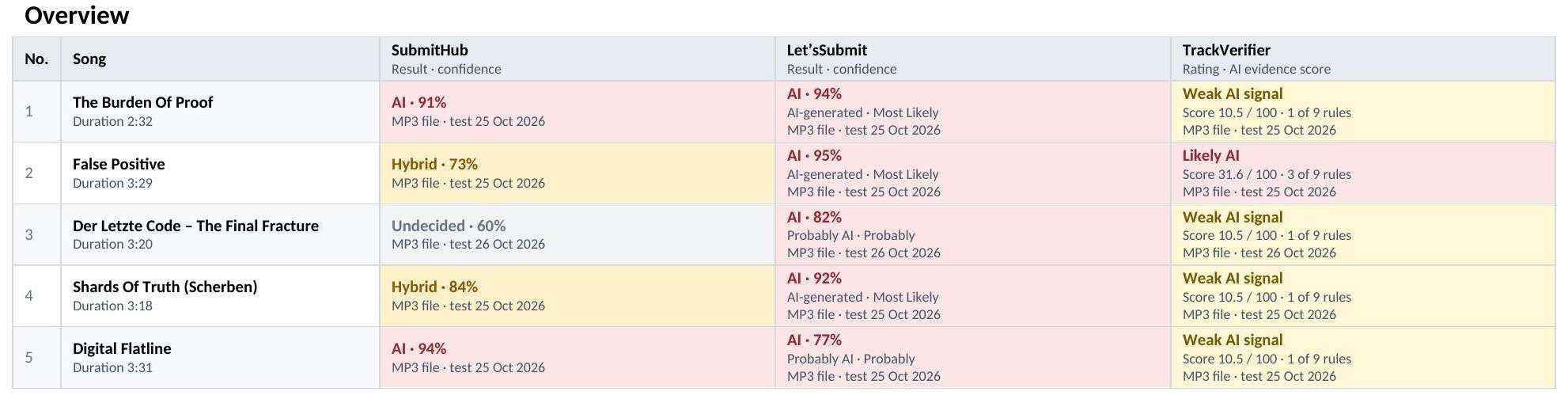
AI music detectors also disagree with each other and sometime with themselves. On Coloured Tears’ latest five-song single, none of the 15 results across SubmitHub, Let’sSubmit, and TrackVerifier came back as primarily human created, yet TrackVerifier scored four of the five at 10.5 out of 100 and called them only a “weak AI signal,” while Let’sSubmit rated all five as AI at 77% to 95% confidence.
Let’sSubmit also gave different verdicts on the same MP3 files a week apart, moving “Flat Land” from ‘Probably Human’ at 61% to ‘Probably AI’ at 65%. Genre may play a part in this, since the human music used to benchmark detectors skews towards mainstream Western pop. IAM, the PR firm behind Grafert’s testing, says it knows of no study that has examined musical niches like darkwave or similar.
SubmitHub does offer an appeals process and Jason raises fair questions about how Grafert’s vocals were processed, though no independent production files have been published to settle the matter. The open question for DSPs is whether a score designed to express uncertainty should be allowed to carry the weight of an official ruling.