In 2016, when composer Takeshi Furukawa finally finished the score for acclaimed video game The Last Guardian, he was a broken man. He’d toiled for five years on the project – crafting a grand orchestral backdrop against which the moving fairytale of a small boy and his huge avian friend could play out. It had been a significant success – racking up more than a million in sales and an array of awards – but the long days and nights, as well as emotional strain, had proved too much. He needed a break, and badly.
“It was my first really big solo project,” says Furukawa, zooming in from a quiet suburb in Orange County, California, where he lives with his partner and young child. “Throughout the writing process there was always this fear of not being good enough, like a rain cloud on top of me… Afterwards, I needed to offload that.”
So, like all good millennials, he decided to go on holiday to Tokyo. Furukawa’s parents are Japanese and he speaks the language fluently, but he had never lived there himself – never experienced the bustling streets of Japan’s futuristic, neon-lit capital as an adult, never wandered through Ueno Park amid the falling cherry blossom. It felt like the perfect place to slow down and “just exist”. At the very least, he “didn’t want to think about music.”
Takeshi Furukawa at work. CREDIT: PressFurukawa has been thinking about music for most of his life. Clearly gifted from a young age, he played piano, violin and then viola through childhood – though his more macho dad thought a son should be in karate class – and later attended the prestigious Berklee College Of Music, graduating in 2003. A steady trickle of film and TV work gradually grew into a torrent and soon, Furukawa’s credits comprised most of the biggest franchises in Hollywood – from Star Wars and Star Trek to James Bond video games. The Last Guardian bookended more than a decade of dutiful grind. No wonder he was “burned out”.
The holiday turned into a year in Tokyo – just “vegging out” – before the lure of the studio proved too strong. “I was doomscrolling through Twitter one day,” remembers Furukawa, “when I stumbled upon this beautiful image from a new video game.” It depicted a young girl and her small animal companion, standing together amid lush, green grass while looking up nervously at a spindly black robot perched on a rock. “I thought it would be wonderful to set music to something like this.”
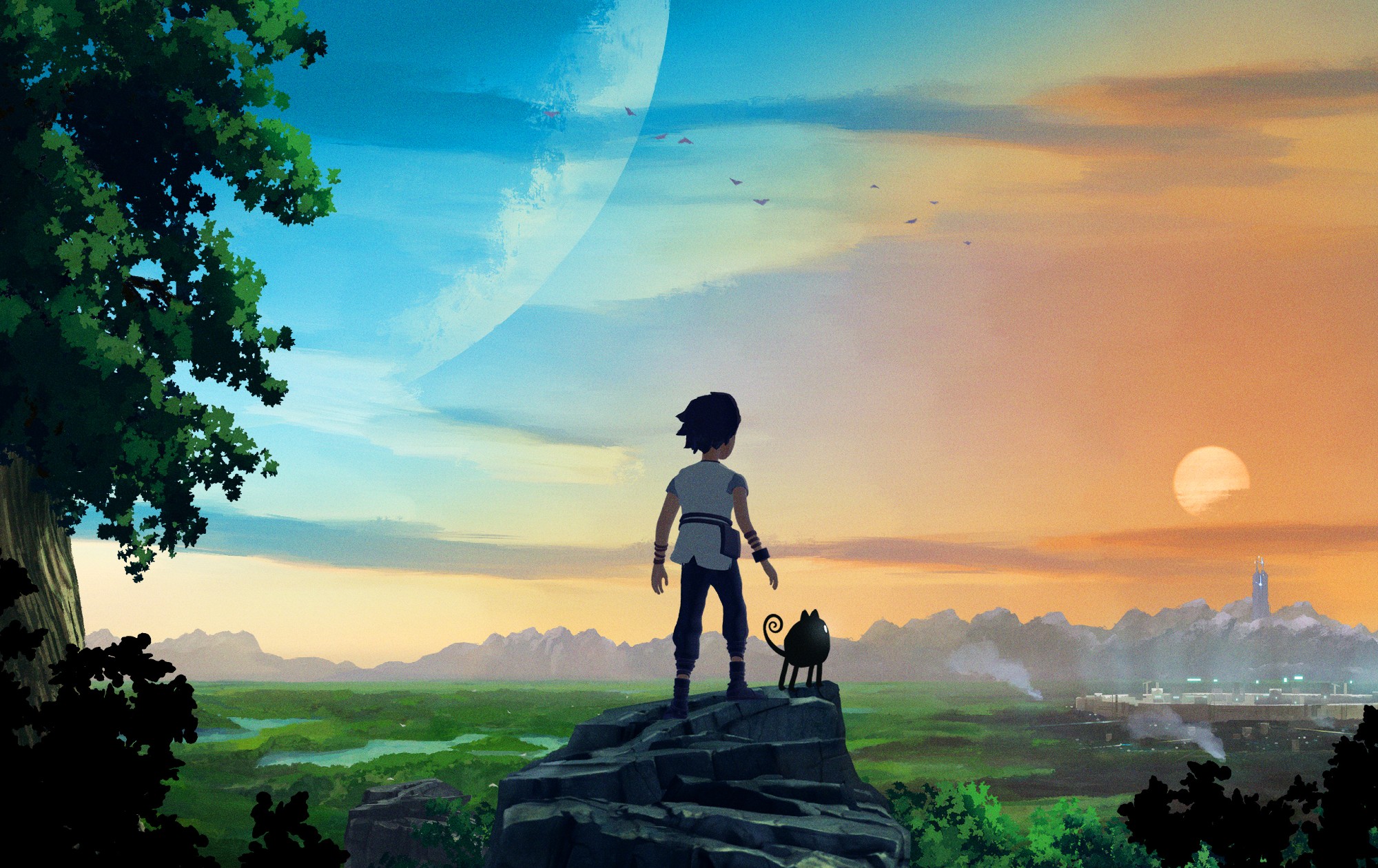
If you’ve played the acclaimed puzzle-platformer Planet Of Lana, you’ll recognise the shot instantly. It’s on the cover, first posted on social media in 2018. There’s not a lot of action going on, but the digitally hand-painted concept art hints at the game’s surprisingly complex themes of survival, friendship and environmentalism. Designed in an arresting, painterly style and centring on a child hero alongside their faithful creature sidekick, the comparisons to The Last Guardian are obvious. Well, to most people.
“It didn’t really occur to me that the subject matter was quite similar,” Furukawa tells NME today. In the background, we can see the whitewashed interior of his office through the screen. There are no pictures on the wall, and nothing on his desk but a keyboard and computer, no distractions from his main task of writing. “The visuals were just so striking that they completely drew me into the world.”
So affected was Furukawa – and against usual industry practice – that he emailed Adam Stjärnljus, head of the Swedish indie studio Wishfully and Planet Of Lana game director, to offer his services. “He thought someone was playing a prank on him!” laughs Furukawa. “The Last Guardian inspired the style guide behind the game so he really thought someone was pulling his leg… Luckily, he responded anyway and we got talking. The earnest work on the project began in around 2020.”
Takeshi FurukawaFast-forward nearly seven years and Furukawa has soundtracked two full-length Planet Of Lana games. His scores are emotional and adaptable, transitioning from comforting, Spielbergian string themes that make you feel like a five-year-old scoffing popcorn in the cinema to sinister trumpet fanfares which herald an incoming enemy or tricky boss battle. His greatest skill, though, is knowing when to pull back for more melancholic scenes – perhaps a key character death or when protagonist Lana is reunited with her lost loved ones in the first game. These moments have real power.
“For me, aesthetically, less is more,” says Furukawa. “I think it might be a quasi-Japanese sensibility that was instilled in me from my childhood… Clarity is one of the things that I really value in music, just presenting [it] in a very digestible, clear manner – not complicating things. The simpler [the music] is, the bigger emotional resonance you can get.”
This is certainly true of the series’ memorable main theme, which revolves around nine carefully selected notes. Reworked and rearranged by Furukawa into different versions of the same motif, the recurring melody helps to ground Lana’s adventures and weaves together different chapters into one long story. It’s easily the most recognisable piece from either game, but Furukawa says he can’t take total credit for it. He had help.
“It was actually my daughter,” the composer chuckles. “She was about two or three years old and just starting to plunk around on the piano. I wanted to write something which would be as simple as possible for her to play. Her hands were tiny and the max she could stretch was, like, one fifth [interval] on the keyboard. [The main theme] fits her hand movements.”
‘Progeny’, the track in question which contains Planet Of Lana’s main theme, is by far the title’s most-streamed song on Spotify (542,000 spins and counting) – and has notched hundreds of thousands more plays on YouTube. In a world where video game scores are increasingly consumed outside of the environments for which they were designed – i.e. not while playing the game – does Furukawa ever change his approach to making game music?
“Yes and no,” he quibbles. “I’ve been very fortunate that, when I work on the games, my directors always tell me to just ‘write the music, don’t worry about the interactive implementation.’ I think it gets too pedantic if I’m thinking: ‘OK, I need to do a vamp here or a loop there… But whenever I have the pleasure of doing one of these interviews, I always think you guys know more about my music than I do! So it does make me think if I should be more analytical [in the studio]…”
He’ll get his chance, if he wants it. Shortly after the sequel’s release in March, Wishfully confirmed it plans to complete the Planet Of Lana trilogy with a third game. Add to that a long-requested vinyl release (which Furukawa confirms to NME is in the pipeline) and the future looks bright for more projects in this space. “It’s such a privilege to get these emails about all the new things that are coming out of the game,” says Furukawa.
With the growing wave of video game concerts taking over venues around the globe, could we also see Planet Of Lana live dates dropping into the diary anytime soon? “I would love that!” he says, genuinely hopeful. “It’s a very symphonic score. It would translate well to the concert hall.”
‘Planet Of Lana’ and ‘Planet Of Lana 2: Children Of The Leaf’ are available to stream now via Milan Records/Sony Music
The post The quiet beauty of the ‘Planet Of Lana’ indie game score – and how it saved its composer appeared first on NME.