
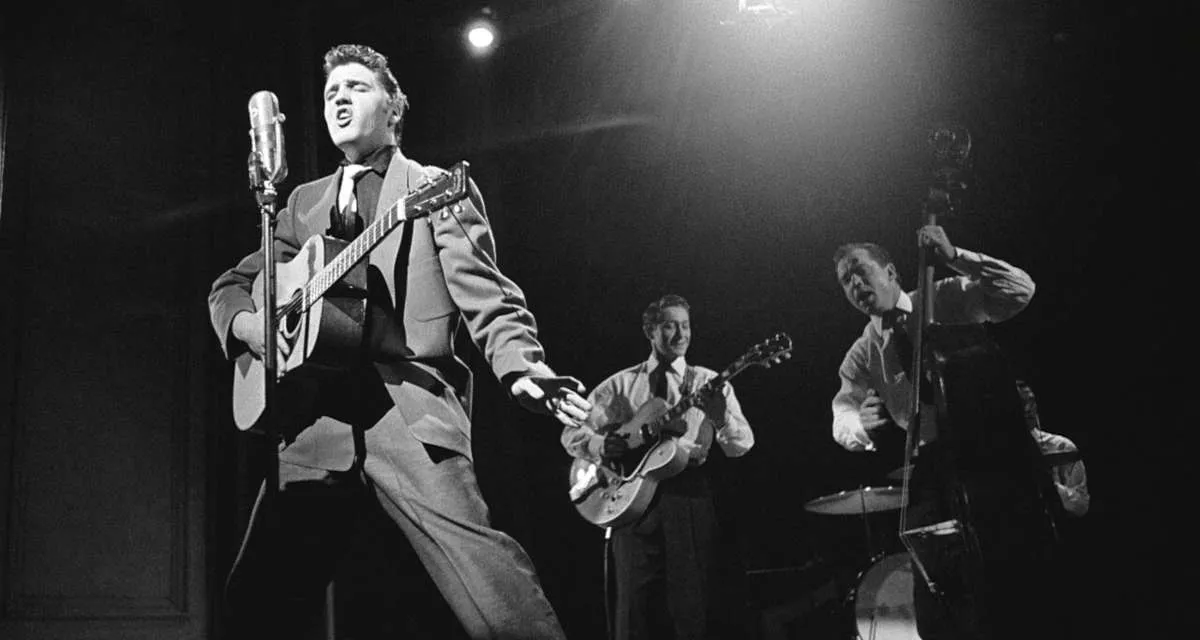
Elvis Presley performing with Scotty Moore and Bill Black in 1956.
Another day, another AI infringement lawsuit – this time against Suno, which is accused of infringing a number of Elvis Presley copyrights as well as the King of Rock’s name, image, and likeness (NIL) rights.
Plaintiffs including Elvis Presley Enterprises, Raleigh Music Publishing, and a subsidiary of Elvis IP owner Authentic Brands Group (ABG) just recently submitted the firmly worded suit to a California federal court.
Besides marking the latest addition to a pile of Suno litigation – more here in a moment – the action arrives on the heels of a separate-but-similar complaint filed by Presley’s rightsholders against Anthropic.
Across both cases, the plaintiffs are repped by veteran entertainment attorney Richard S. Busch, who’s also litigating against Suno on behalf of Gerencia 360, Round Hill Music, and Reservoir Media.
This leads to an important element of Elvis Presley Enterprises v. Suno: The legal text draws heavily from a growing list of findings, admissions, and developments in the AI arena.
That includes references to Suno’s licensing agreements with the likes of Warner Music Group (WMG) and Believe. In a nutshell, the pacts are said to demonstrate that there is, in fact, a market for training deals and that the defendant neglected to secure the required authorization when developing its initial models.
As many know, Suno retired said models with the rollout of v6 in partnership with WMG. But the way Elvis Presley Enterprises sees things, the implementation of fresh guardrails under v6 “is at least a tacit admission that the previous safeguards were not effective enough to prevent copyright infringement regarding output.”
And Suno users can allegedly “easily create unlicensed derivative works merely by submitting them themselves,” with the company purportedly proceeding to “take these user submissions and further train its models on them despite the guardrails.”
As for Suno’s longstanding fair use position, the AI upstart allegedly “lost” on the defense against GEMA in the Munich Regional Court.
Additionally, authors’ ultimately settled Anthropic class action is said to have established that “the practice of indefinite retention [of IP] in a general-purpose archive is legally distinct from the narrower act of purchasing and scanning works solely to train a specific model.”
“Suno has engaged in the same conduct, and the indefinite retention of unlicensed copies of copyrighted works, under Bartz I, does not constitute fair use. Building and maintaining a permanent stockpile of copyrighted material for open-ended future exploitation fails every factor of the fair-use analysis,” the newly submitted suit reads.
All that said, Elvis Presley Enterprises’ Suno action is also heavy on examples of the platform’s allegedly infringing outputs – among them generations that allegedly feature the “Can’t Help Falling in Love” singer’s voice and/or lyrics.
Those “are NOT examples of Elvis Presley singing,” the complaint spells out, but “are synthetic and unlicensed uses of Elvis’ voice and likeness, which have been reproduced, published, publicly performed, distributed, displayed and made available to the public by Suno to sell its products and services.”
Following the claims to their logical conclusion, “Suno was never meant to be a tool for artists to create music but was instead always meant to replace the artists whose works and identities were being unlawfully copied,” the plaintiffs maintain, citing a Suno investor’s related tweet for good measure.
Overall, Elvis Presley Enterprises and the other filing parties are seeking relief for alleged violations of the ELVIS Act and Tennessee’s common law publicity right; direct infringement (referring in part to alleged stream-ripping and unauthorized training); and alleged violations of the DMCA’s anti-circumvention and CMI-removal provisions.
Factoring based on the maximum statutory damages alone, the rightsholders are demanding north of $152 million for alleged DMCA violations and infringement extending to 859 total works.


